Tabla de contenidos
Introducción
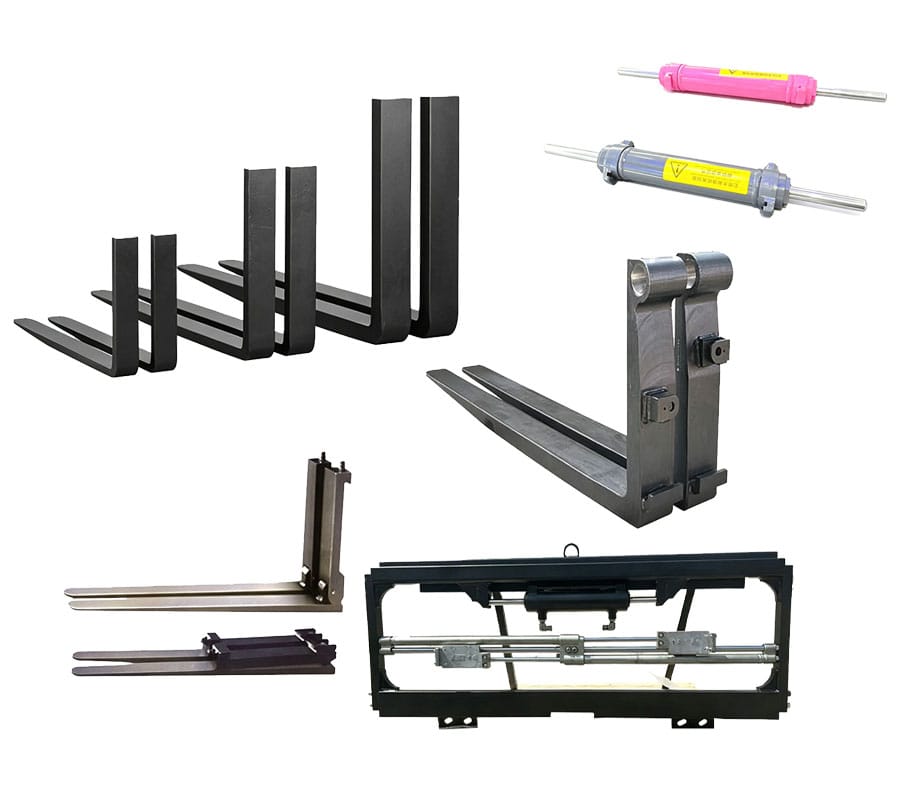
The right forklift attachment can turn a standard lift truck into a more specialized material-handling system. It may reduce repositioning, support unusual loads, improve load control, and help operators complete repetitive tasks more consistently. The wrong attachment, however, can restrict visibility, reduce usable capacity, damage products, or create an unnecessarily complicated workflow.
That is why choosing forklift attachments should not begin with a product catalog. It should begin with a clear description of what you handle, how you handle it, and where the work takes place.
A carretilla elevadora is designed around a rated load, a defined load center, a mast, a carriage, forks, hydraulic systems, and a counterweight. Adding an attachment changes how this complete system behaves. The attachment has its own weight, thickness, center of gravity, hydraulic demand, and operating characteristics. lection process therefore needs to answer five questions:
- What does the load look like?
- What must the attachment do to the load?
- Can the forklift safely support the combined configuration?
- Will the attachment fit the carriage and hydraulic system?
- Can operators use, inspect, and maintain it consistently?
This guide explains how to answer those questions without overcomplicating the buying process.
Comience con la carga, no con el accesorio para montacargas
Many attachment selection problems begin when a buyer chooses a familiar attachment name before documenting the actual load. A side shifter, clamp, rotator, fork positioner, or extension may sound suitable, but the load determines whether that choice will work in practice.
Identifique el formulario de carga
Begin by classifying the products or materials being moved. Common load forms include:
- Palletized cartons
- Drums and cylindrical containers
- Paper, textile, or material rolls
- Baled products
- Bagged materials
- Long profiles, pipes, timber, or panels
- Loose material in bins or containers
- Appliances and large cartons
- Loads without pallets
- Loads with unstable or irregular centers of gravity
The attachment must engage the load in a controlled way. Forks support a pallet from underneath, while clamps apply pressure from the sides. Rotators turn a load around a horizontal axis. Push-pull systems move slip-sheet loads without relying on a conventional pallet.
These functions are not interchangeable. A load that can tolerate vertical support may not tolerate lateral clamping pressure. A rigid load may remain stable when rotated, while a flexible or partially filled load may shift unexpectedly.
Mida las cargas operativas reales
Do not base the decision only on a typical load. Record the full operating range.
Important measurements include:
- Minimum and maximum load weight
- Load width, depth, and height
- Distance from the fork face to the load center
- Pallet opening dimensions
- Load surface material
- Degree of load compression
- Stability during acceleration, braking, and turning
- Frequency of changes in load size
- Required stacking height
- Required rotation or side movement
A useful field method is to review a representative group of actual loads instead of measuring only one sample. Include the widest, narrowest, heaviest, lightest, most fragile, and least stable loads. This exposes exceptions that may otherwise appear only after installation.
Comprenda los principales tipos de accesorios para montacargas
Forklift attachments are designed to solve different handling problems. Understanding their primary functions helps you create a realistic shortlist.
Cambiadores laterales
A side shifter moves the fork carriage laterally without requiring the operator to reposition the whole truck. It is useful when loads must be aligned accurately with pallets, racks, platforms, or vehicles.
A side shift forklift attachment can be particularly valuable in operations with repeated pallet placement, restricted maneuvering room, or frequent alignment corrections. ction variables include carriage compatibility, overall width, lateral travel, capacity, mounting type, hydraulic connections, and the effect of the attachment thickness on the load center.
Posicionadores de horquillas
Fork positioners allow the operator to adjust the spacing between the forks hydraulically. They are useful when load widths change frequently during a shift.
They can reduce the need for operators to leave the cab and manually move the forks. However, a fork positioner does not automatically make every load suitable for standard forks. The load must still have safe support points and remain stable during movement.
Rotadores
Rotators allow the forks or an attached container to rotate. They are commonly used when material must be tipped, emptied, inverted, or repositioned.
Before choosing a rotator, consider whether the load will remain secured throughout the rotation. The attachment may require a container, clamp, fork lock, or retaining system. Hydraulic flow, rotation angle, cycle frequency, and hose routing also need careful review.
Abrazaderas
Clamps handle loads by applying controlled pressure. Different designs are used for cartons, bales, rolls, appliances, drums, and other products.
Clamp selection is especially sensitive because excessive force may damage the load, while insufficient force may allow it to slip. The correct contact pad, opening range, friction surface, pressure setting, and load condition all matter.
Accesorios Push-Pull
Push-pull attachments are designed for loads carried on slip sheets. They grip the sheet, pull the load onto a supporting platen, and push it off at the destination.
This approach can reduce dependence on pallets, but it requires compatible load packaging, suitable slip-sheet quality, adequate floor and platform conditions, and operators who understand the engagement process.
Extensiones de horquilla y accesorios de carga larga
Fork extensions increase the supporting length available for certain loads. They must be matched to the existing forks and used only where the load can be supported safely.
Long loads also require attention to balance, turning clearance, deflection, load distribution, and the possibility of the load extending beyond the normal operating envelope.
Estabilizadores de carga y accesorios personalizados
Load stabilizers apply controlled downward pressure to help secure stacked or unstable goods. Custom forklift attachments may combine fork movement, clamping, rotation, extension, or special load-contact surfaces.
Customization is most useful when the load is consistent but cannot be handled efficiently with standard equipment. It should be based on drawings, dimensions, handling sequences, capacity calculations, and a clear definition of the working environment.
Verifique la capacidad del montacargas y el centro de
Rated forklift capacity should never be treated as a fixed value that applies to every attachment and every load position.
Por qué puede cambiar la capacidad nominal
A forklift is rated for a defined load center and configuration. When an attachment is added, its weight becomes part of the total supported load. Its thickness may also move the working load farther away from the fork face.
This increases the forward load moment. In simple terms:
Load moment = load weight × horizontal distance from the supporting reference point
Even when the product weight does not change, moving its center of gravity farther forward increases the overturning effect on the truck.
Peso del accesorio y centro de carga efectivo
An attachment affects capacity in two ways:
- Its own weight consumes part of the forklift’s lifting capability.
- Its mounting thickness may increase the effective load center.
This is why a light attachment with a thick frame can still have a meaningful effect on residual capacity. A compact attachment may preserve more capacity and visibility than a deeper design, even when both perform the same basic function.
Capacidad residual
Residual capacity is the usable lifting capacity of the forklift after accounting for the installed attachment, load center, lift height, mast configuration, and other relevant factors.
It should be verified using approved technical information rather than estimated from the forklift’s original nominal rating. The final configuration should be reflected in the applicable capacity documentation or data plate.
Do not assume that a forklift rated for a particular load can lift that same load at every height or with every attachment.
Confirme la compatibilidad del transporte y el montaje
Forklift attachments are not automatically universal. Two trucks with similar nominal capacities may have different carriage dimensions, fork sections, hydraulic layouts, or mast configurations.
Clase de transporte
The carriage is the structure that travels along the mast and supports the forks or attachment. Matching the carriage class is one of the first compatibility checks, but it is not the only one.
Confirm:
- Carriage width
- Upper and lower hook dimensions
- Hook spacing
- Locking method
- Espaciado de horquillas
- Backrest arrangement
- Available clearance
- Mast and roller interference points
A correct carriage-class description does not guarantee complete compatibility if the attachment width, hydraulic ports, hoses, or frame interfere with other components.
Método de montaje
Attachments may be:
- Hook-mounted
- Shaft-mounted
- Fork-mounted
- Bolt-on
- Welded into a dedicated carriage
- Integrated with another attachment
Removable designs may support operational flexibility, but frequent installation and removal create additional inspection and connection requirements. Permanently mounted designs may provide a more compact and stable configuration for dedicated work.
Dimensiones de la horquilla
Fork-mounted attachments must match the fork width, thickness, length, taper, locking arrangement, and allowable load.
Excessive clearance may allow movement during travel. Insufficient clearance may prevent proper installation or create concentrated stress. Measurements should be taken from the actual forks rather than relying only on a model description.
Evaluar los requisitos hidráulicos y de control
Mechanical compatibility is only part of the selection process. Hydraulic forklift attachments must also match the truck’s available pressure, flow, control functions, and hose arrangement.
Presión y flujo hidráulicos
Pressure influences the force available for clamping, shifting, positioning, lifting, or rotation. Flow influences operating speed.
More flow does not always mean better performance. Excessive speed can make precise load handling difficult, while insufficient flow can make the attachment slow during high-frequency work.
The correct configuration balances:
- Required operating force
- Desired movement speed
- Duty cycle
- Hydraulic temperature
- Hose and fitting capacity
- Control sensitivity
Funciones hidráulicas adicionales
A basic side shifter may need one hydraulic function. A combined attachment may require two or more functions.
Check whether the forklift already has enough control valves and hose lines. When hydraulic functions are shared through a selector valve, operators must understand how to switch between movements without activating the wrong function.
Hose Routing
Hydraulic hoses should move freely throughout the complete mast range without being stretched, crushed, twisted, or caught between components.
Review the configuration at:
- Full lowering
- Full lift
- Forward and backward mast tilt
- Maximum side shift
- Maximum clamp opening
- Full rotation
- Any reach or extension position
A hose arrangement that appears acceptable at ground level may become unsuitable when the mast is elevated.
Match the Attachment to the Operating Environment
A technically compatible attachment may still perform poorly if it does not suit the workplace.
Aisle Width and Turning Space
Attachments can increase the truck’s overall width, length, or front overhang. This affects turning clearance, rack approach, doorway access, container entry, and maneuvering around equipment.
Measure the narrowest real operating space, not just the main aisle. Loading zones, rack ends, doorways, staging areas, and congested corners often create the actual restriction.
Floor and Surface Conditions
Uneven floors increase load movement and attachment vibration. Outdoor or mixed-surface operation may introduce impact, dust, moisture, and debris.
The attachment should provide sufficient structural strength and load retention without making the overall configuration unnecessarily heavy.
Environmental Exposure
Consider whether the attachment will encounter:
- Dust or abrasive particles
- Moisture
- Corrosive materials
- High or low operating temperatures
- Frequent washdown
- Fibers or packaging debris
- Repeated impact
- Long periods of outdoor storage
Pins, bearings, seals, pads, surfaces, hoses, and protective finishes should be selected accordingly.
Duty Cycle
An attachment used occasionally has different requirements from one completing repeated cycles throughout a shift.
High-cycle applications place greater importance on:
- Bearing and bushing durability
- Hydraulic temperature control
- Seal quality
- Hose movement
- Pad wear
- Lubrication access
- Replacement-part availability
- Inspection frequency
Consider Visibility, Load Stability, and Operator Safety
A good attachment should help the operator control the load without creating avoidable blind spots or unpredictable movement.
Forward Visibility
Frames, cylinders, hoses, valves, and load backrests may obstruct the operator’s view. Visibility becomes especially important when entering pallets, placing loads at height, or working close to racks and equipment.
Assess visibility with the attachment:
- Empty
- Carrying the narrowest load
- Carrying the widest load
- At travel height
- At stacking height
- Fully shifted or positioned
A compact frame can improve visibility, but structural requirements should not be compromised simply to create a more open appearance.
Load Stability
The attachment should support or retain the load during acceleration, braking, turning, lifting, lowering, and placement.
For clamps, stability depends on pressure, friction, pad area, load strength, and the position of the center of gravity. For forks, it depends on support length, spacing, load distribution, and engagement depth.
Operator Training
Operators need training on the specific attachment rather than only the base forklift.
Training should cover:
- Control functions
- Capacity limitations
- Approved load types
- Load engagement
- Safe travel position
- Stacking procedures
- Inspection points
- Emergency response
- Prohibited uses
Clear controls and repeatable procedures are often more valuable than adding functions that operators rarely need.
Compare Common Forklift Attachments
The following table provides a practical starting point. Final selection still depends on the forklift configuration and actual load data.
| Attachment Type | Best-Suited Application | Key Selection Variables | Typical Hydraulic Need | Important Operating Consideration |
|---|---|---|---|---|
| Side shifter | Accurate pallet and rack alignment | Width, side travel, capacity, frame thickness | One function | Attachment thickness may move the load center forward |
| Posicionador de horquilla | Loads with frequently changing widths | Opening range, fork type, minimum spacing | One function | Fork spacing must still support the load correctly |
| Rotator | Tipping, emptying, or inverting loads | Rotation range, torque, retention method | One function | The load must remain secured during rotation |
| Carton or appliance clamp | Palletless boxed goods | Clamp force, pad size, opening range | One or two functions | Incorrect pressure can damage or release the load |
| Roll clamp | Cylindrical rolls | Roll diameter, weight, contact pads, rotation | One or two functions | Contact pressure and roll surface protection are critical |
| Bale clamp | Compressed or baled materials | Opening range, arm design, friction | One function | Load density and compression vary between materials |
| Push-pull | Slip-sheet handling | Sheet quality, platen size, load packaging | One or two functions | Requires consistent slip-sheet presentation |
| Extensiones de horquilla | Longer unit loads | Fork dimensions, extension length, support ratio | Usually none | Longer support changes maneuvering and load-center conditions |
| Load stabilizer | Tall or unstable stacked loads | Contact area, pressure, vertical range | One function | Downward force must not damage the product |
| Custom attachment | Repeated specialized load | Complete load and workflow data | Application-specific | Engineering review and controlled testing are essential |
Use a Weighted Selection Method
When several forklift attachments appear suitable, a weighted evaluation can prevent the decision from being based on one attractive feature.
The following scoring method is an original practical framework rather than a certification formula.
Step 1: Establish Mandatory Gates
A candidate should be rejected before scoring if it fails any mandatory requirement:
- Verified forklift compatibility
- Acceptable residual capacity
- Safe load engagement
- Suitable hydraulic configuration
- Adequate operating clearance
- Available technical documentation
Safety and compatibility should never be traded for productivity points.
Step 2: Weight Operational Priorities
A typical evaluation might use these categories:
- Load control: 25%
- Forklift compatibility: 20%
- Productivity improvement: 15%
- Visibility: 15%
- Maintenance access: 10%
- Flexibility across load sizes: 10%
- Operator simplicity: 5%
The percentages should reflect your workflow. A fragile-load operation may assign more weight to load control, while a high-frequency pallet operation may prioritize alignment speed and visibility.
Step 3: Score Each Candidate
Score each attachment from one to five for every category. Multiply the score by the category weight and compare the totals.
Do not treat the highest score as an automatic final decision. Use it to identify tradeoffs and questions that need further verification.
Step 4: Conduct a Controlled Trial
Where practical, test the proposed configuration using representative loads and trained personnel.
Observe:
- Load engagement time
- Number of truck repositioning movements
- Visibility at critical points
- Load movement during travel
- Placement accuracy
- Control response
- Hydraulic temperature
- Hose movement
- Product marking or damage
- Operator workload
A short trial with the wrong test load has limited value. Use the difficult loads identified during the initial load survey.
Review Productivity Without Ignoring Operational Fit
The best forklift attachments improve the complete handling cycle, not just one movement.
For example, a fork positioner may reduce manual fork adjustment, but the total benefit depends on how often load widths change. A side shifter may reduce truck repositioning, but its value is lower where loads are handled in wide, open spaces with little placement precision.
Evaluate the full cycle:
- Approach the load.
- Align the attachment.
- Engage the load.
- Secure or support it.
- Lift and travel.
- Position it at the destination.
- Release the load.
- Return for the next cycle.
An attachment that saves time during engagement but slows release or obstructs visibility may not improve the complete process.
It is also possible to over-specify an attachment. Additional functions increase weight, controls, hydraulic connections, inspection points, and operator decisions. Select the simplest configuration that safely completes the required work.
Inspect Maintenance and Service Requirements
Maintenance requirements should be considered before purchase, not after a problem develops.
Daily Inspection Points
Depending on the design, operators should inspect:
- Mounting hooks and locks
- Forks or arms
- Welds and structural members
- Pins and retainers
- Hydraulic hoses and fittings
- Cylinders
- Contact pads
- Bearings and bushings
- Chains or guides
- Labels and capacity information
- Unusual movement or leakage
The attachment should not be used when damage, excessive wear, loose mounting, uncontrolled movement, or hydraulic leakage affects safe operation.
Wear Components
Clamps, positioners, side shifters, and rotators contain components that move under load. Pads, slides, bushings, bearings, seals, and hoses may require periodic replacement.
Ask whether these components can be inspected and replaced without dismantling unrelated parts of the attachment.
Technical Documentation
Useful documentation should include:
- Attachment identification
- Capacidad nominal
- Load-center conditions
- Mounting instructions
- Hydraulic requirements
- Inspection guidance
- Lubrication points
- Wear limits
- Parts information
- Approved operating procedures
For unusual loads or custom configurations, technical attachment consultation should be based on the forklift model, carriage dimensions, hydraulic information, load drawings, working height, and handling sequence rather than a product name alone. ractical Forklift Attachment Selection Process
A repeatable process makes selection easier to document and reduces the risk of missing an important requirement.
Step 1: Document the Loads
Record dimensions, weights, surfaces, packaging, centers of gravity, and load variations.
Step 2: Map the Handling Cycle
Describe how the load is collected, transported, stacked, rotated, emptied, aligned, and released.
Step 3: Record Forklift Specifications
Collect the forklift model, rated capacity, load center, mast type, lift height, carriage dimensions, fork dimensions, hydraulic functions, and capacity documentation.
Step 4: Shortlist Attachment Types
Choose the attachment function that matches the load problem. Avoid adding functions that are unrelated to the workflow.
Step 5: Verify Compatibility and Residual Capacity
Review the complete forklift, attachment, and load combination. Do not rely on the forklift’s original nominal rating.
Step 6: Review Visibility and Clearance
Check the configuration in actual aisles, doorways, racks, platforms, and stacking positions.
Step 7: Conduct a Representative Trial
Use difficult and typical loads. Record handling performance instead of relying only on operator impressions.
Step 8: Finalize Documentation and Training
Update operating instructions, inspection points, capacity information, and operator training for the final configuration.
Step 9: Monitor Early Operation
During the first operating period, review wear, hose movement, load damage, hydraulic temperature, operator feedback, and cycle consistency.
Common Forklift Attachment Selection Mistakes
Selecting by Attachment Name Alone
Knowing that you need a clamp or side shifter is not enough. Opening range, pressure, capacity, frame depth, mounting, and load condition determine whether the attachment is suitable.
Ignoring Residual Capacity
The forklift’s original capacity does not automatically remain available after an attachment is installed.
Assuming Universal Compatibility
Similar-looking carriages and forks may have different dimensions or mounting details.
Overlooking Visibility
An attachment may function correctly while making precise load placement more difficult.
Choosing One Attachment for Incompatible Loads
A highly variable load range may require adjustable contact surfaces, interchangeable components, or more than one attachment.
Failing to Consider the Whole Cycle
Improving one movement does not guarantee better overall productivity.
Skipping Operator Input
Operators can identify visibility restrictions, control difficulties, unstable packaging, and workflow exceptions that may not appear in technical specifications.
Operator feedback should support the engineering review, not replace it.
Conclusión
Choosing forklift attachments is a load-management decision, not simply a product-selection decision.
Start by documenting the load and the complete handling cycle. Then verify residual capacity, load center, carriage compatibility, hydraulic requirements, operating clearance, visibility, load stability, maintenance access, and operator controls.
The most suitable attachment is not necessarily the one with the most functions. It is the configuration that safely controls the real load, fits the forklift correctly, performs consistently in the actual workplace, and remains practical to inspect and maintain.
A load-first evaluation, supported by technical documentation and a controlled trial, gives you a far more reliable result than choosing by attachment type alone.
Preguntas frecuentes
Are forklift attachments universal?
No. Compatibility depends on carriage dimensions, mounting style, fork size, hydraulic functions, capacity, mast configuration, and operating clearance. Even forklifts with similar rated capacities may require different mounting arrangements or attachment specifications.
Do forklift attachments reduce lifting capacity?
They often reduce usable capacity because the attachment adds weight and may move the load center farther forward. Residual capacity should be verified for the complete forklift, attachment, load center, mast, and lift-height configuration before operation.
How do I know which forklift attachment fits my forklift?
Collect the forklift model, carriage class and dimensions, fork measurements, rated capacity, load center, lift height, mast type, and hydraulic information. These details should be reviewed together with the attachment dimensions and actual load data.
Which forklift attachment is suitable for loads of different widths?
A fork positioner may suit palletized or supported loads with changing widths, while an adjustable clamp may be needed for loads handled from the sides. The correct choice depends on support points, load strength, width range, and stability.
How often should forklift attachments be inspected?
Operators should complete a visual and functional check before use, while detailed inspections should follow the manufacturer’s instructions, duty cycle, working environment, and applicable requirements. High-cycle or harsh applications may need more frequent checks.