Table of Contents
Forklift hydraulic cylinder must be specified around a real installation. In replacement actuators on material-handling equipment, the purchasing question is how forklift hydraulic cylinders should satisfy application changes that require a new review. This guide focuses on that decision and the evidence a buyer should collect before releasing work. It does not assign a new machine capacity or claim a universal service interval.
The review of forklift hydraulic cylinder should begin with bore and rod diameters, stroke, mounting centers. A clear drawing, known host configuration and an agreed acceptance plan make the supplier conversation more useful. The following checks explain how to turn those inputs into a documented decision.
Identify the actuator's function for forklift hydraulic cylinder
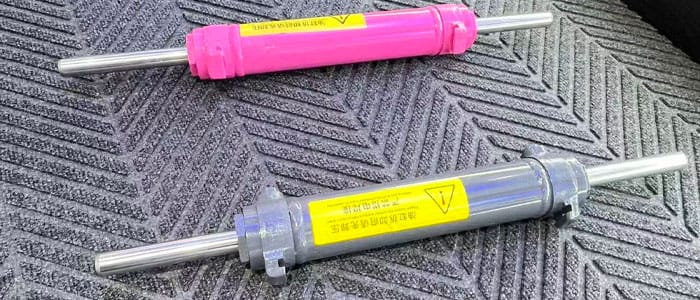
For buyers evaluating forklift hydraulic cylinder, a forklift may use different cylinders for lifting, tilting and attachment movement. Those functions impose different installation and control requirements. State the exact function and host assembly in the inquiry. A generic description such as hydraulic cylinder leaves the supplier unable to confirm mounting geometry, operating pressure or the required movement. Include the original part number where available, but check it against the actual assembly revision.
Separate stroke from installed length for forklift hydraulic cylinder
When specifying forklift hydraulic cylinder, stroke is the cylinder's movement, while closed and extended mounting lengths describe its installation envelope. Two cylinders can share a stroke and have different mounting-center distances. Record the center-to-center length in the specified closed condition, the stroke and the extended length, plus the end connection geometry. These dimensions should reconcile on the drawing. Do not force an apparently similar cylinder into an installation by altering mounting points.

Match the hydraulic specification for forklift hydraulic cylinder
In a review of forklift hydraulic cylinder, confirm the working pressure range, port specification, fluid compatibility and temperature conditions with the responsible equipment information. Bore and rod dimensions affect available force and the difference between extension and retraction behavior. Connection thread size alone does not establish compatibility. Record any required sealing arrangement, cushioning or control features rather than assuming the replacement shares the original internal construction.
Make installation evidence complete for forklift hydraulic cylinder
For a project involving forklift hydraulic cylinder, the delivered cylinder should be linked to its drawing, identification and agreed test record. Inspect mounting features, rod condition, ports and protective caps before installation. Commissioning belongs to a competent installer using the equipment and cylinder instructions, with stored energy controlled. Keep the final connections and operating boundary in the maintenance record so that future replacements reproduce the approved arrangement.
Define the change affecting forklift hydraulic cylinder
For buyers evaluating forklift hydraulic cylinder, a change review for forklift hydraulic cylinder begins by describing what will be different from the approved application. That may be the load base, center of gravity, host machine, available space, hydraulic conditions or duty pattern. Write the previous condition and the proposed condition side by side. Avoid a vague description such as heavier work or a slightly longer load. Record confirmed values and mark uncertain information. The purpose is to identify the technical questions that must be resolved before production assumes the existing arrangement remains suitable.
When specifying forklift hydraulic cylinder, for replacement actuators on material-handling equipment, examine the interfaces most likely to be affected: bore and rod diameters, stroke, mounting centers. A change in one part of the process can have consequences elsewhere. Different packaging may alter support contact; an adapter may increase projection; a replacement actuator may change end positions. The review should follow those relationships through the actual assembly. Do not assume that an unchanged nominal load or part name means the installation is unchanged. Ask the equipment owner to identify the approval and operating information governing the current configuration.
Trace the load or motion through forklift hydraulic cylinder
When specifying forklift hydraulic cylinder, the assessment of forklift hydraulic cylinder should follow the physical path from the load or actuator through its connections to the supporting machine. Identify contact points, retainers, guides and structural interfaces. Where motion is involved, review the complete permitted envelope, including clearances at the extremes. For a supported load, confirm the real center of gravity and the support arrangement. For a hydraulic component, include the circuit and linkage behavior. This system view helps avoid improving one component while leaving a different limiting interface unresolved.
In a review of forklift hydraulic cylinder, use calculations to answer defined questions and expose assumptions. A static force or moment estimate can be useful for preliminary comparison, but it is not automatically a final capacity or service-life prediction. Dynamic effects, geometry, material condition and the equipment's approved rating may require additional assessment. Keep the calculation inputs and units visible. If a value comes from an estimate or an old component measurement, identify that limitation. The responsible engineer should decide which evidence is sufficient for the proposed change and which further information is needed.
Compare practical responses for forklift hydraulic cylinder
When reviewing forklift hydraulic cylinder, consider several responses to the changed requirement. The process might be adjusted to preserve the existing approved arrangement, the component might be replaced with a reviewed design, or a different equipment configuration might be needed. Compare the effect on fit, load support, inspection, maintenance and installation effort. The option with the smallest purchase price may create a more difficult operating or maintenance condition. Conversely, a larger component may add mass or interfere with surrounding structures without addressing the actual problem.
Ask suppliers to identify the assumptions behind each proposal. A useful response includes a drawing, stated scope and the conditions under which the proposal applies. If a vendor offers a substitute, assess its effect on connected parts rather than comparing only the headline size. Keep the current approved design as a reference until the new arrangement has passed its required review. Avoid making irreversible alterations during the evaluation stage. A controlled comparison makes it easier to decide whether the proposed change is necessary and what evidence will establish its suitability.
Validate and record the changed forklift hydraulic cylinder configuration
Before the changed forklift hydraulic cylinder arrangement enters routine service, complete the required equipment approval, installation and commissioning steps. Define who authorizes release and which documents must be updated. The acceptance demonstration should cover the changed feature and the interfaces it affects, using the manufacturer's instructions and competent personnel. Record the final part identity, drawing revision, operating boundary and any relevant inspection changes. Staff should be able to identify the installed configuration without relying on the memory of the person who organized the modification.
After introduction, review observations from the intended duty without treating an absence of early problems as proof of unlimited capability. Unexpected interference, abnormal movement, recurring damage or uncertain identification should return to the responsible technical team. Keep future changes under the same process. A change review is successful when it produces a clear, approved operating arrangement and a durable record. It should leave procurement, production and maintenance with the same understanding of what changed, why it was accepted and what would require another assessment.
A practical review example for forklift hydraulic cylinder
Consider an illustrative procurement review for replacement actuators on material-handling equipment. The buyer has an existing installation, a drawing marked revision A and a supplier proposal marked revision B. No production result or customer case is implied by this example. The first review question is whether bore and rod diameters, stroke, mounting centers are stated on both drawings using the same reference convention. Put the confirmed requirement, proposed value and evidence beside each other. An omitted dimension remains an open question; it does not become acceptable merely because the rest of the drawing appears similar.
For forklift hydraulic cylinder, suppose the proposal changes one interface while retaining the advertised product name. Ask the supplier to identify the change and its effect on the mating assembly. If the difference changes fit, support or motion, obtain the responsible technical assessment before release. If it is accepted, issue a revised controlled drawing and carry that revision into the order, receiving record and equipment file. This example shows a decision method, not a universal dimensional limit or a substitute for equipment approval.
Decision and evidence comparison
| Decision point | Incomplete basis | Evidence to request |
|---|---|---|
| Application | Product name alone | replacement actuators on material-handling equipment |
| Critical interfaces | Overall size or photograph | bore and rod diameters, stroke, mounting centers |
| Compatibility | It fits during an unloaded check | Approved drawing and host-configuration review |
| Manufacturing scope | Generic quality claim | Specified material, processing and traceable inspection |
| Release | An informal message | Accepted revision, documented deviations and receiving record |
For general workplace context, consult the UK HSE lift-truck guidance. Its workplace guidance complements the equipment instructions; this link does not certify a Techence product or replace application-specific technical approval.
Review Techence’s Hydraulic cylinder product page, then send Techence your drawing and application requirements for confirmation of the proposed scope.
To discuss forklift hydraulic cylinder, prepare the current drawing revision, quantity, host equipment details and the evidence needed for application changes that require a new review. Ask Techence to confirm the available configuration and identify any assumptions before quotation or production release.
Frequently asked questions
What information is needed for forklift hydraulic cylinder in this application?
Provide the host equipment identity, a current drawing and a description of replacement actuators on material-handling equipment. Identify bore and rod diameters, stroke, mounting centers, the supplied scope and any unknown requirements. Distinguish original design values from measurements taken from a worn part. The supplier can then confirm the proposal against a defined interface instead of guessing from the product name.
Can a matching size prove that forklift hydraulic cylinder is compatible?
No. Overall size is only one comparison. For forklift hydraulic cylinders, check bore and rod diameters, stroke, mounting centers and the effect on connected components, load geometry or motion. Material condition and approved operating requirements also need the appropriate evidence. A controlled fit assessment supports the decision but does not establish the capacity of the complete machine.
Which records should accompany forklift hydraulic cylinder?
Keep the approved drawing revision, component identification, agreed inspection results and any required functional or test records together. The evidence should identify the delivered unit or set and state the scope actually checked. For forklift hydraulic cylinders, retain the mating-assembly information so that later replacements can reproduce the approved configuration.
When should the forklift hydraulic cylinders application be reviewed again?
Review a change in host equipment, intended load, support arrangement, installation envelope or operating requirements that affects the approved configuration. Pay particular attention to bore and rod diameters, stroke, mounting centers. A substitute part or revised supplier drawing also needs assessment against the controlled requirement. The equipment owner and responsible engineer should resolve the affected interfaces before release.
How can a buyer request a quotation for forklift hydraulic cylinder?
Send Techence the application description, drawing, quantity, equipment details and documentation requirements. State that the inquiry concerns forklift hydraulic cylinders and application changes that require a new review. Ask the team to identify assumptions and proposed alternatives explicitly. Confirm the final drawing and scope before manufacture; published category information alone cannot determine the correct configuration for every installation.