Table of Contents
Introduction
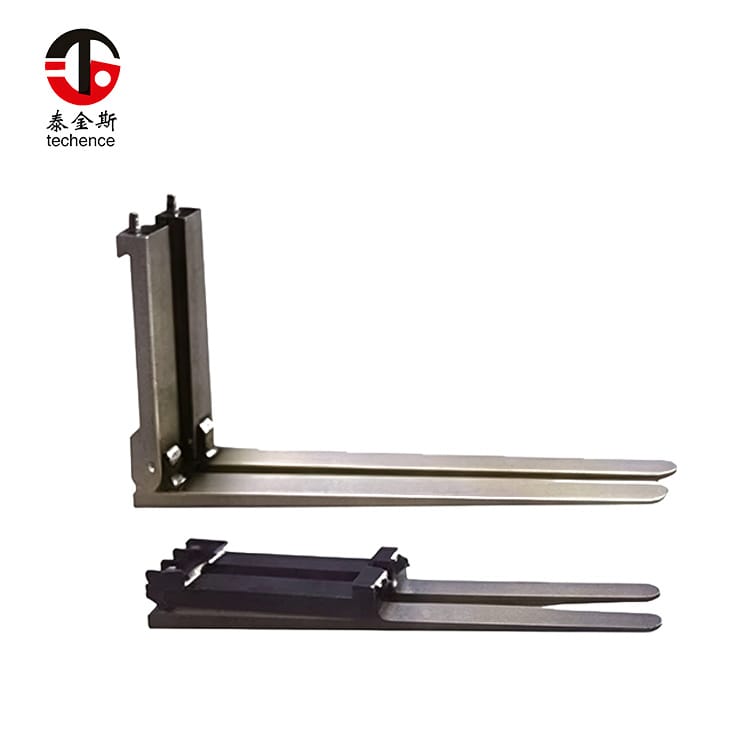
Understanding forklift fork class sizes is essential when matching hook-type forks to a forklift carriage. Two forks can have similar blade lengths, widths, and thicknesses yet still be incompatible because their upper and lower hook positions are designed for different carriage classes. For this reason, fork class should be checked together with blade dimensions whenever a fork configuration is being identified, replaced, or adapted to another material-handling application.
Fork classes provide a standardized way to organize the mounting relationship between hook-type forks and forklift carriages. Classes such as Class II, Class III, and Class IV are commonly seen on warehouse and industrial equipment, while other classes cover lighter or heavier configurations. The class number mainly relates to carriage and mounting dimensions rather than simply describing the physical size or strength of the fork blade.
This guide explains how forklift fork classes work, the common carriage heights associated with different classes, the difference between Class A and Class B mounting arrangements, how to identify an existing fork class, and what other specifications need to be confirmed before matching forks to a carriage.
What Are Forklift Fork Classes?
A forklift uses a carriage at the front of the mast to support forks and, in some applications, additional load-handling attachments. On a conventional hook-type system, the rear of each fork has an upper and lower hook that engages with the carriage bars. The geometry of these mounting points must correspond with the carriage.
Fork classes were developed to standardize this interface. Instead of every forklift using completely different hook positions, common mounting classes provide defined dimensional relationships that make it easier to identify compatible fork and carriage configurations.
The class number should not be confused with blade dimensions. A Class III fork, for example, does not automatically have one fixed length, width, or thickness. Different Class III forks can have significantly different blade sections and lengths while sharing the mounting geometry needed to fit a Class III carriage.
This distinction is particularly important for industrial equipment because the same carriage class may be used with forks designed for different loads and applications.
Common Forklift Fork Class Sizes
Forklift fork classes are commonly identified by the approximate vertical height of the carriage mounting interface. The following table provides a practical reference for widely recognized ITA-style hook-type classes.
| Fork Class | Approx. Carriage Height | Metric Reference | General Application Range |
|---|---|---|---|
| Class I | 13 in | 330 mm | Light material-handling equipment |
| Class II | 16 in | 406 mm | Common warehouse forklifts |
| Class III | 20 in | 508 mm | Medium and heavier industrial forklifts |
| Class IV | 25 in | 635 mm | Heavy industrial forklifts |
| Class V | 28.7 in | About 728 mm | Larger heavy-duty equipment |
These dimensions are useful for preliminary identification, but they should not be treated as the only information required to determine compatibility. Upper hook position, lower hook position, fork back height, carriage geometry, and equipment specifications still need to be verified.
Fork class standards are intended primarily to organize mounting dimensions. They do not mean that every fork within the same class has identical load capability or blade geometry.
Why Fork Class Is Different From Fork Size
Fork size normally describes dimensions such as blade length, width, and thickness. Fork class describes the mounting relationship between the fork and carriage. Both sets of information are important, but they answer different technical questions.
Consider two hook forks with identical blade dimensions of 50 mm thickness, 125 mm width, and 1,200 mm length. If one uses a Class II mounting arrangement and the other uses Class III hooks, they cannot simply be treated as interchangeable. Their blades may look almost identical from the front, but the vertical hook geometry at the rear is different.
The opposite situation can also occur. Two Class III forks may both fit the same class of carriage while having substantially different blade dimensions. One may be designed for conventional pallet handling, while another may have a wider section or longer blade for an industrial load.
A complete fork specification therefore needs to identify both fork dimensions and mounting class rather than relying on either factor alone.
Understanding Class A and Class B Forks
Fork class identification can include both a number and a letter, such as 2A, 3A, 4A, or corresponding B-type arrangements. The number indicates the primary class, while the letter describes differences in the vertical mounting position of the fork.
Class A and Class B arrangements within the same numerical class use different lower mounting relationships. This affects how the fork sits relative to the carriage and the ground. As a result, a fork identified only as “Class III” may still require additional confirmation before it is matched to an existing carriage.
The distinction becomes particularly important when equipment requires specific under-clearance characteristics. Some forklifts are configured for warehouse floors, while others may work on outdoor surfaces or applications where additional clearance beneath the fork mounting area is useful.
For this reason, fork identification should include the complete designation whenever possible rather than recording only the numerical class.
How to Identify the Fork Class on a Forklift

The most reliable starting point is the forklift identification information. The equipment data plate, technical documentation, or carriage specification may identify the fork carriage class directly. If this information is available and still corresponds to the current equipment configuration, it can simplify identification.
Physical measurement provides another useful method. Carriage height can be measured vertically across the mounting interface and compared with the commonly recognized class dimensions. A carriage around 16 inches high generally points toward Class II, while approximately 20 inches indicates Class III and approximately 25 inches indicates Class IV.
However, carriage height should be used as part of the identification process rather than as the only measurement. The upper carriage bar, lower carriage bar, hook positions, and overall fork back geometry should also be checked.
Existing fork markings can provide additional information. Depending on the manufacturer and fork configuration, markings may identify capacity, load center, material information, class, or other production details. Clear photographs of these markings can be useful when evaluating an existing fork configuration.
Why Carriage Height Matters
Carriage height establishes the vertical distance over which the fork mounting system engages with the forklift. As forklift size and application requirements increase, larger carriage classes are commonly used to provide an appropriate mounting structure.
A Class II carriage, for example, is substantially shorter than a Class IV carriage. A fork designed for one cannot simply be moved to the other because the upper and lower hooks will not align correctly.
This is why visually comparing blade dimensions can be misleading. The section visible underneath the load may look suitable, while the rear mounting geometry prevents correct engagement with the carriage.
Carriage dimensions also influence attachments such as fork positioners, side shifters, and other carriage-mounted components. Whenever an attachment interfaces with the same carriage system, the class becomes part of the overall compatibility assessment.
Class II Forklift Forks
Class II is commonly associated with many compact and conventional warehouse forklifts. The approximate carriage height is 16 inches, or about 406 mm, and the class is frequently encountered in pallet handling, logistics, manufacturing, and general indoor material-handling applications.
Forks within this class can still vary considerably. Blade length may change according to pallet depth, while width and thickness can vary according to the intended load and fork design. Full taper and other blade configurations may also be used without changing the underlying carriage class.
This illustrates why describing a component simply as a “Class II fork” does not provide a complete technical specification. The class confirms part of the mounting interface, but blade geometry and capacity information must still be evaluated separately.
Class III Forklift Forks
Class III uses a larger mounting interface, with an approximate carriage height of 20 inches or 508 mm. It is frequently seen on medium-capacity industrial forklifts and equipment operating with larger or denser loads.
Because of the broader application range, Class III forks may appear in warehouse operations as well as manufacturing, lumber, construction materials, metal processing, and other industrial environments. Blade dimensions can vary substantially depending on the material being handled.
Techence produces hook forklift forks in several mounting configurations, including 2A, 3A, and 4A arrangements. This demonstrates how the mounting class can change while the broader product category remains the same.
When evaluating Class III forks, the complete A or B designation, blade dimensions, load center, carriage configuration, and fork condition should all be checked rather than relying only on the numerical class.
Class IV Forklift Forks
Class IV forks are associated with an approximately 25-inch, or 635 mm, carriage height and are generally found on larger industrial forklifts. These machines may be used for steel, heavy machinery, construction materials, timber, stone, and other loads that exceed the requirements of conventional warehouse handling.
The larger mounting class does not mean every Class IV fork has the same blade section. Depending on the application, forks may differ in thickness, width, length, taper, heel geometry, and material specification.
Heavy operating environments can also place greater demands on the carriage connection. Hook engagement, locking components, carriage bars, and fork condition therefore deserve regular inspection in addition to the blade itself.
A correct Class IV mounting arrangement should be evaluated as one part of the overall forklift, carriage, fork, and load system.
What About Class I and Class V?
Class I represents a smaller hook-type mounting arrangement with an approximate carriage height of 13 inches or 330 mm. It is more commonly associated with lighter material-handling equipment where the required fork and carriage structure is smaller than that used on conventional medium-capacity forklifts.
Class V sits at the opposite end of the common class range, with an approximate carriage height of 28.7 inches or around 728 mm. It is associated with larger equipment and demanding industrial applications.
However, very large forklifts do not always rely on conventional hook-type fork classes. Heavy port, mining, and specialized industrial machines may use pin-mounted, shaft-mounted, roller, or fully customized fork systems. In these situations, class terminology may become less useful than a complete dimensional drawing of the mounting interface.
This is particularly relevant for extremely heavy-duty applications where the fork geometry and connection system are developed specifically around the machine and load.
Fork Class Does Not Define Fork Capacity Alone
A common misunderstanding is that fork class automatically determines how much load a fork can support. Although class ranges are associated with different forklift sizes, the mounting class itself does not define the complete rated capability of the individual fork.
Fork capacity is influenced by blade thickness, width, length, heel geometry, steel properties, heat treatment, load center, manufacturing method, and other engineering factors. Two Class III forks can therefore have different rated characteristics even though both attach to the same class of carriage.
The forklift itself also has its own rated capacity. Installing physically larger forks does not increase the capability of the truck. Mast configuration, carriage, load center, attachments, and equipment design continue to determine the operating limits of the complete system.
Fork class should therefore be viewed primarily as a compatibility specification for the mounting interface.
Why Load Center Still Matters
Fork class identifies how the fork attaches to the carriage, but the position of the load remains critical. Load center describes the horizontal relationship between the fork face and the center of gravity of the load under the specified operating condition.
A fork can have the correct class and still be unsuitable if its length or application causes the load to be positioned differently from the intended configuration. Long loads, deep pallets, machinery, and irregular industrial components can move the center of gravity farther forward.
For this reason, class identification should be followed by an evaluation of blade dimensions and actual load characteristics. Fork class answers the question of mounting compatibility, while load center and fork geometry help determine whether the configuration suits the intended handling task.
These factors should not be evaluated independently.
How Fork Length Relates to Fork Class
A carriage class does not prescribe one fixed fork length. Class II, III, and IV forks can all be produced in multiple blade lengths depending on the intended load.
A warehouse application may use relatively conventional blade lengths to match common pallets, while industrial equipment within the same carriage class may use longer forks for machinery or large materials. This means fork length should be selected according to the load rather than assumed from the class number.
Changing length can also influence load position and maneuverability. A substantially longer blade may extend beyond smaller loads or create additional clearance requirements in narrow operating areas.
The class must remain compatible with the carriage, while the blade length must remain suitable for the material and equipment configuration.
How Fork Width and Thickness Relate to Fork Class
Width and thickness are also independent of the class designation. Forks within the same mounting class can use different blade cross sections to meet different application requirements.
A relatively narrow blade may be useful when pallet openings are limited, while wider blades can provide a larger support surface beneath machinery or industrial products. Thickness contributes to the fork cross section but must be evaluated together with material, geometry, and rated characteristics.
This is why simply identifying “Class III” or “Class IV” is not sufficient when defining a fork. At minimum, the blade length, width, thickness, mounting class, and relevant load information should be considered together.
For specialized applications, shank height, taper, hook position, tip geometry, and other dimensional information may also be required.
Common Fork Class Identification Mistakes
One frequent mistake is identifying the fork class based only on forklift capacity. Although certain classes are commonly associated with particular equipment ranges, different machines can use different carriage configurations. The actual carriage and equipment specification should therefore be checked.
Another mistake is measuring only the blade. Blade length, width, and thickness reveal nothing about whether the hooks will align with the carriage. The rear mounting geometry needs equal attention.
It is also easy to overlook the A or B portion of the class designation. Two forks from the same numerical class may have different mounting relationships, so the complete designation should be confirmed whenever possible.
Finally, equipment that has been modified during its operating life deserves particular attention. A replacement mast, carriage, side shifter, or other attachment may change the original configuration, meaning the current physical measurements can be more useful than relying exclusively on the original forklift model.
What Information Is Needed to Confirm Fork Compatibility?
A clear technical assessment should begin with the forklift manufacturer, model, rated capacity, load center, and current carriage configuration. The carriage class should be recorded when known, but physical dimensions can also be used for confirmation.
Fork information should include blade length, width, thickness, back height, hook configuration, and any readable identification markings. Clear photographs of the carriage, upper hook, lower hook, locking mechanism, and complete fork can help clarify the mounting arrangement.
For non-standard configurations, dimensional drawings are particularly useful. They can show the exact relationship between the blade, shank, hooks, carriage bars, and locating points without relying on assumptions about class terminology.
This approach is especially important for older equipment, modified forklifts, heavy-duty machinery, and applications using specialized fork mounting systems.
Fork Classes and Custom Fork Configurations
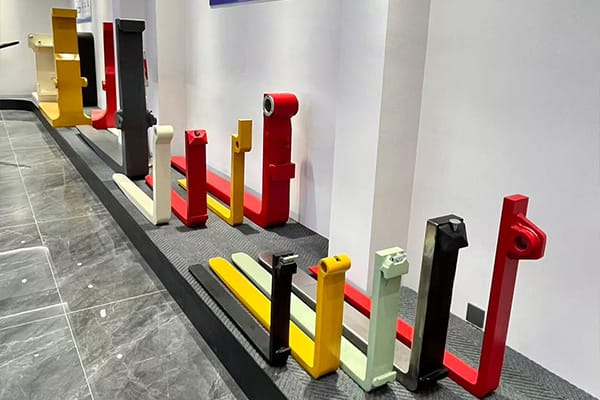
Standardized fork classes are extremely useful for conventional hook-type forklift systems, but not every application fits within those boundaries. Ports, mines, steel plants, heavy machinery facilities, and other demanding environments may use fork configurations that differ substantially from standard warehouse equipment.
Pin-type forks, shaft-mounted forks, roller forks, and other specialized systems are identified primarily through their physical mounting dimensions rather than conventional ITA-style hook classes.
Custom hook forks may also be produced for a recognized carriage class while using non-standard blade dimensions. In this case, the class maintains carriage compatibility while length, width, thickness, taper, and other features are adapted to the load.
The most reliable configuration therefore combines standardized mounting information where applicable with application-specific fork geometry.
Conclusion
Understanding forklift fork class sizes makes it easier to distinguish between blade dimensions and carriage compatibility. The fork class mainly defines the mounting relationship between hook-type forks and the carriage, while fork length, width, thickness, material, capacity, and load center describe other aspects of the component.
Common carriage references include approximately 13 inches for Class I, 16 inches for Class II, 20 inches for Class III, 25 inches for Class IV, and about 28.7 inches for Class V. These measurements provide a useful starting point, but the complete mounting geometry and A or B designation should still be verified.
A correct class does not automatically mean a fork is suitable for an application. Fork dimensions, load characteristics, carriage configuration, equipment specifications, and operating environment must all be evaluated together.
For standard hook forks, identifying the complete class and mounting geometry provides a much stronger basis for compatibility. For pin, shaft, roller, or highly specialized heavy-duty forks, detailed dimensional information becomes even more important.
FAQ
What are forklift fork class sizes?
Forklift fork class sizes identify standardized mounting dimensions for hook-type forks and carriages. Common classes include Class I through Class V, with each class using a different carriage and hook geometry.
What is the difference between Class II and Class III forklift forks?
The main difference is the mounting geometry. Class II commonly corresponds to an approximately 16-inch carriage height, while Class III uses an approximately 20-inch carriage height. Blade dimensions can vary within both classes.
How do I identify my forklift fork class?
Check the forklift documentation, data plate, carriage information, and fork markings first. Carriage height and hook positions can then be measured to confirm the mounting class.
Does fork class determine fork capacity?
No. Fork class mainly defines mounting compatibility. Fork capacity also depends on blade dimensions, material, geometry, heat treatment, load center, and the complete engineering design.
Can forks from different classes fit the same carriage?
Normally, different numerical classes use different vertical mounting dimensions, so the hooks will not align correctly. The fork class and complete mounting geometry should match the carriage configuration.
Need Help Choosing the Right Forklift Fork Class?
If you’re unsure which forklift fork class, hook configuration, blade dimensions, or mounting arrangement is suitable for your equipment, our team is here to help. Different carriage classes and industrial applications can require significantly different fork configurations, so confirming the mounting interface is an important part of achieving a reliable fit.
Contact Techence today for technical support based on your forklift model, carriage dimensions, fork class, load center, and application requirements. A correctly matched fork and carriage configuration can help support stable, efficient material handling across warehouse and heavy-duty operating environments.