Table of Contents
Introduction

A forklift side shifter is a hydraulic attachment that allows the fork carriage and forks to move laterally to the left or right without requiring the operator to reposition the entire forklift. This relatively simple movement can make a significant difference when aligning pallets with racks, positioning materials on production lines, loading vehicles, or working in areas where there is limited space for repeated steering adjustments.
Side shifting is especially useful in applications where accurate positioning is required throughout the working day. Instead of repeatedly moving the truck forward, backward, and sideways to correct small alignment differences, the operator can make controlled lateral adjustments through the hydraulic system. This can support smoother handling while reducing unnecessary forklift movement around racks and loads.
However, a forklift side shifter is not simply an accessory that can be added without technical evaluation. Carriage class, side-shift travel, hydraulic cylinder dimensions, mounting configuration, attachment thickness, load center, fork arrangement, and forklift operating characteristics all influence how the complete system performs. This guide explains how side shifters work, their main components, suitable applications, compatibility factors, maintenance considerations, and how to define an appropriate configuration.
What Is a Forklift Side Shifter?
A forklift normally raises and lowers loads through the mast while the forks remain positioned relative to the carriage. A side shifter adds controlled lateral movement, allowing the fork assembly to move a limited distance to either side of the forklift centerline.
The attachment is typically installed between the carriage and the forks or integrated into the carriage structure. A hydraulic cylinder provides the force required to move the sliding frame across a guided surface. When the operator activates the hydraulic control, the cylinder moves the carriage or fork-supporting section laterally.
This movement does not change the distance between the two forks. Both forks normally move together as one assembly. This is an important distinction because a side shifter and a fork positioner perform different functions. A side shifter changes the lateral position of both forks together, while a fork positioner changes the spacing between the individual fork arms.
In some material-handling systems, these two functions are combined so the operator can adjust both fork spacing and lateral position from the forklift controls.
How a Forklift Side Shifter Works
The basic operating principle is hydraulic. Pressurized hydraulic fluid enters a cylinder, causing the piston and rod to move. The cylinder is connected between fixed and moving sections of the attachment, converting hydraulic pressure into lateral movement.
Guide surfaces or sliding components keep the moving section aligned with the carriage. The travel distance is limited by the attachment design and cylinder stroke so the forks remain within the intended working range.
When hydraulic flow is directed in one direction, the carriage moves to one side. Reversing the hydraulic flow moves it in the opposite direction. The operator can therefore make relatively small alignment corrections without changing the position of the forklift itself.
Smooth movement depends on the relationship between hydraulic pressure, cylinder condition, guide surfaces, carriage geometry, and load. Uneven movement, excessive resistance, hydraulic leakage, or abnormal play can indicate that one or more parts of the system require inspection.
The hydraulic circuit should provide controlled movement rather than sudden lateral motion. This becomes increasingly important when the forklift is carrying tall, heavy, or uneven loads.
Main Components of a Forklift Side Shifter
Although side-shifter designs vary, most systems include a structural frame, moving carriage section, hydraulic cylinder, sliding or bearing surfaces, mounting components, hydraulic hoses, fittings, and fork-supporting elements.
The structural frame transfers load forces between the forks, attachment, carriage, and mast. It must therefore remain dimensionally stable throughout lifting and lateral movement.
The hydraulic cylinder provides side-shift motion. Cylinder bore, rod diameter, stroke, mounting points, sealing system, and working pressure all influence the movement characteristics of the attachment.
Guide components keep the moving frame aligned. Depending on the design, these areas may use sliding pads, bearings, wear surfaces, or other guiding elements. Wear in these components can create excessive clearance and affect movement accuracy.
Hydraulic hoses need enough flexibility to accommodate full travel while avoiding excessive bending or contact with moving parts. Hose routing is therefore part of the overall attachment design rather than an isolated hydraulic detail.
Side Shifter vs Fork Positioner
Side shifters and fork positioners are sometimes confused because both change the position of the forks, but they solve different material-handling problems.
A side shifter moves the complete fork assembly left or right while maintaining the existing distance between the forks. Its primary purpose is lateral alignment. This is useful when a pallet is slightly offset from the forklift or when the load needs a small adjustment before being placed into a rack.
A fork positioner changes the distance between the forks. It is useful when the forklift handles pallets, frames, skids, or loads with different widths and operators frequently need to adjust fork spacing.
The difference can be summarized as follows:
| Function | Side Shifter | Fork Positioner |
|---|---|---|
| Moves both forks left/right together | Yes | Not its primary function |
| Changes distance between forks | No | Yes |
| Helps with pallet alignment | Yes | Indirectly |
| Adapts to different load widths | Limited | Yes |
| Uses hydraulic operation | Commonly | Commonly |
| Can be combined with other functions | Yes | Yes |
Some systems combine side shifting and fork positioning. This can be useful in applications where both load width and lateral alignment change frequently.
Where Forklift Side Shifters Are Most Useful

Warehouse rack operations are one of the most common environments for side-shift functionality. When a pallet is slightly misaligned with the rack opening, a small lateral correction can make positioning easier without requiring repeated steering movements.
Loading platforms and transport vehicles can also benefit from side shifting. Pallets inside a trailer or container may not always be positioned perfectly relative to the forklift approach path. Controlled lateral adjustment can help the operator align the forks or load more accurately.
Manufacturing facilities may use side shifters when materials need to be positioned against fixtures, machines, production lines, or storage locations. Small differences in alignment can matter when working around fixed equipment.
Construction-material operations, steel handling, timber facilities, logistics centers, and industrial production environments can also use side shifting where repeated lateral alignment is part of daily material movement.
The value of the attachment depends less on industry name than on how frequently the operator needs to correct load position without moving the entire forklift.
Side-Shift Travel and Working Range
Side-shift travel describes how far the attachment can move laterally from its central position. The required range depends on the forklift, carriage width, attachment structure, fork position, and application.
More travel is not automatically better. Excessive lateral movement can place the load farther from the forklift centerline, which changes the relationship between the load and the truck. The required travel should therefore reflect actual alignment needs.
In many applications, side shifting is used for relatively small corrections rather than large changes in load position. The operator approaches the load or storage position with the forklift approximately aligned and then uses the side shifter for final adjustment.
The attachment should also maintain suitable mechanical engagement throughout its full travel. Guide surfaces, cylinder stroke, hoses, and mounting components must all remain within their intended operating ranges.
For non-standard equipment, technical drawings can help define center position, maximum left travel, maximum right travel, carriage width, and cylinder stroke as one complete dimensional system.
Why the Hydraulic Cylinder Is Important
The hydraulic cylinder is one of the key functional components in a side shifter. Its dimensions and internal condition directly influence the speed, force, and range of lateral movement.
Cylinder bore affects the relationship between hydraulic pressure and output force, while stroke determines the available linear movement. Rod diameter, seals, mounting geometry, and hydraulic connections also need to correspond with the attachment design.
A cylinder that does not match the required stroke may prevent the attachment from reaching its intended travel range. Incorrect mounting dimensions can create alignment problems, while unsuitable sealing or surface condition can affect hydraulic performance.
Techence provides hydraulic cylinders for side-shifter applications across different forklift tonnage ranges and industrial handling configurations. Cylinder dimensions can therefore be evaluated together with the attachment structure rather than as a separate component.
For technical matching, useful information includes cylinder bore, rod diameter, stroke, installation length, mounting style, port location, forklift range, and operating application.
Carriage Compatibility
A side shifter needs to match the forklift carriage correctly. Conventional forklifts often use standardized carriage classes that define the mounting relationship between the mast, carriage, forks, and attachments.
Class II, Class III, and Class IV configurations are common across different forklift ranges, but class identification alone may not provide every required dimension. Carriage height, mounting bars, hook geometry, overall width, and attachment interface should still be checked.
An attachment designed for one carriage class should not be assumed suitable for another simply because the forklift capacities appear similar. A mismatch can affect mounting engagement, fork position, and overall geometry.
Equipment that has been modified during its service life deserves particular attention. A forklift may have a replacement mast, carriage, fork positioner, or other attachment that differs from its original configuration.
For this reason, current physical measurements and clear photographs can be more useful than relying only on the forklift model when the existing equipment history is uncertain.
How a Side Shifter Affects Load Center
A side shifter adds structure between the forklift carriage and the load. This additional thickness can move the fork face and load farther forward compared with a basic carriage-and-fork configuration.
Moving the load farther forward changes the relationship between the load center and the forklift. Attachment mass also contributes to the total load carried by the mast.
Lateral movement introduces another consideration. When a load is shifted away from the truck centerline, its position relative to the forklift changes. This effect is particularly relevant with heavy, tall, or unevenly distributed loads.
The forklift, attachment, forks, and material should therefore be considered as one complete system. The original forklift rating should not be interpreted independently from attachment geometry and load position.
Side shifting should primarily be used for controlled alignment rather than as a way of carrying a load continuously at the maximum lateral position without considering operating conditions.
Side Shifters for Pallet Handling
Pallet handling is one of the clearest applications for a forklift side shifter. Warehouse aisles and storage racks often provide limited space for large steering corrections, especially when the forklift is working at height.
Without side shift, a small alignment error can require the operator to lower or reposition the truck before trying again. With lateral adjustment available, the fork position can be corrected more precisely while the truck remains substantially in the same location.
This function can also help when pallet positions are not perfectly consistent. Damaged pallets, uneven storage positions, trailer movement, or differences in loading arrangement can all create small alignment variations.
Side shifting does not eliminate the need for correct forklift positioning. The truck should still approach the load as accurately as practical. The attachment is best used for final correction rather than compensating for a significantly incorrect approach angle.
Side Shifters in Industrial Applications
Industrial loads can be more complex than conventional pallets. Machinery bases, fabricated steel, molds, timber, construction components, and other materials may require accurate placement relative to fixed equipment or storage supports.
Side shifting can help align these materials without repeated movement of the entire forklift. This is particularly useful when floor space is restricted or when the load needs to be positioned against a fixture or reference point.
However, irregular loads require greater attention to center of gravity. A machine may appear geometrically balanced but contain a motor or gearbox that concentrates weight on one side.
Lateral movement should therefore be carried out with an understanding of both load shape and weight distribution. Large industrial loads may require smaller, slower adjustments than conventional pallets.
The attachment configuration should reflect the working environment, typical load geometry, required travel range, carriage system, and hydraulic characteristics.
Integrated and Hang-On Side Shifters
Side shifters can be incorporated into the carriage structure or installed as an additional attachment, depending on the equipment design.
An integrated configuration can reduce the amount of additional structure in front of the mast because side-shift capability is incorporated directly into the carriage system. This can help limit additional forward offset.
A hang-on or carriage-mounted side shifter can provide flexibility where an existing forklift needs lateral fork movement. The attachment is installed onto the existing carriage interface and the forks are then supported by the side-shifter frame.
The appropriate design depends on the forklift, carriage, application, available hydraulic circuits, and required geometry.
When attachment depth is important, the distance from the original carriage face to the new fork face should be considered because it affects load position. Overall attachment mass should also be included in the technical evaluation.
Hydraulic Hose and Connection Considerations
Side shifters require reliable hydraulic connections because the cylinder may move repeatedly during a normal working shift. Hoses and fittings therefore need to accommodate both hydraulic pressure and attachment movement.
Hoses should be routed so they do not rub against the mast, carriage, chains, or other moving components. Repeated abrasion can gradually damage the outer hose layer and eventually affect reliability.
The hose length should also correspond with the full movement range. A hose that is too short may become stretched at maximum travel, while excessive hose length can create loops that interfere with nearby components.
Connection points should remain accessible for inspection and maintenance. Leakage around fittings, cylinder ports, or hose connections should be addressed before it affects attachment performance.
Clean hydraulic fluid and suitable sealing conditions also contribute to consistent cylinder operation over time.
Inspection and Maintenance
Regular inspection helps maintain smooth and predictable side-shifter movement. The hydraulic cylinder, hoses, fittings, guide surfaces, carriage hooks, retaining components, and sliding areas should all be checked according to operating conditions.
Hydraulic leakage is an obvious warning sign, but mechanical wear can also affect performance. Excessive clearance in guide surfaces may allow unwanted movement, while dirt or damaged sliding areas can create resistance.
Uneven or jerky travel can indicate hydraulic restrictions, contamination, guide wear, cylinder problems, or misalignment. These symptoms should be investigated rather than treated as normal attachment behavior.
The attachment should also be inspected for deformation, cracks, damaged mounting points, and abnormal wear. Fork retaining components need attention because the forks remain directly involved in supporting the load.
Applications involving dust, outdoor exposure, high operating cycles, or heavy materials may require more frequent inspection than occasional indoor pallet handling.
Common Side Shifter Configuration Mistakes
One common mistake is focusing only on the amount of lateral travel. Travel distance is important, but carriage class, attachment thickness, hydraulic configuration, cylinder dimensions, fork compatibility, and load characteristics are equally relevant.
Another mistake is ignoring the effect of attachment depth. Adding structure in front of the carriage changes the fork-face position and can alter the effective relationship between the load and mast.
Hydraulic compatibility can also be overlooked. A side shifter needs an appropriate hydraulic circuit, control arrangement, hoses, fittings, and cylinder configuration. Additional attachment functions may require further hydraulic capability.
Using maximum side shift as a normal carrying position is another issue. Lateral movement is intended primarily for alignment, and large off-center loads deserve additional consideration because weight distribution relative to the truck changes.
Finally, a side shifter should not be expected to solve incorrect fork spacing. If the application regularly handles different load widths, fork-positioning capability may also be required.
How to Define the Right Side Shifter Configuration
The evaluation should begin with the forklift. Useful information includes the forklift model, rated capacity, carriage class, carriage width, mast configuration, hydraulic system, fork dimensions, and existing attachment arrangement.
The load should then be considered. Weight, width, depth, height, center of gravity, handling frequency, storage position, and required alignment accuracy all influence the attachment requirements.
Next, define the required lateral travel. This should reflect the amount of adjustment genuinely needed during normal operations rather than simply selecting the largest possible movement.
Cylinder dimensions and attachment geometry can then be matched to the travel and carriage requirements. For specialized configurations, drawings can show the center position, side travel, mounting interface, cylinder stroke, overall attachment width, and fork location.
Evaluating these factors together provides a stronger technical basis than treating the side shifter as an independent component.
When a Side Shifter May Not Be Enough
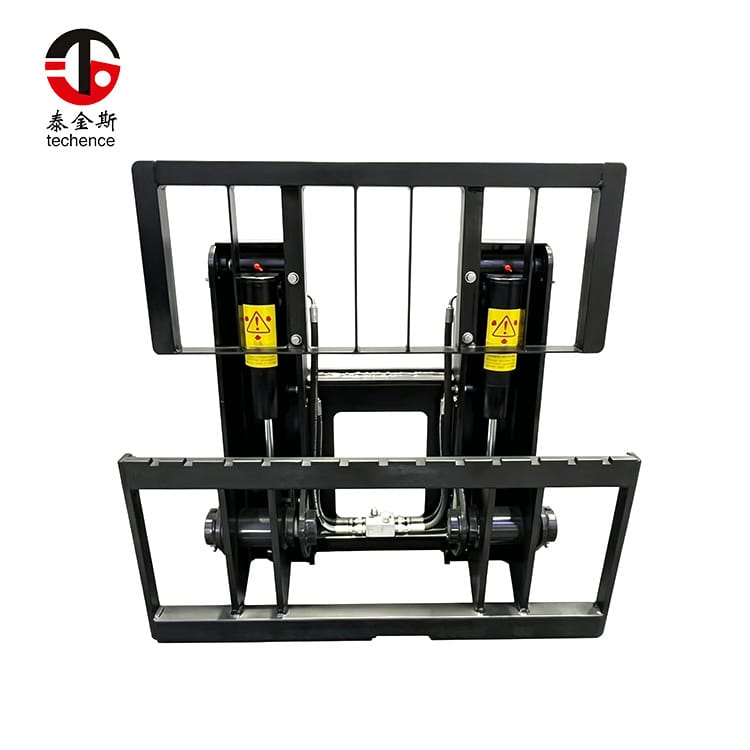
A side shifter solves lateral alignment problems, but some material-handling applications require additional movement.
If the forklift regularly handles loads with different support widths, a fork positioner may be useful because it changes the distance between the forks. If loads require rotation, tilting, clamping, or other movement, different attachment functions may be necessary.
Some applications combine several functions into one attachment system. A side-shifting fork positioner, for example, can provide both lateral movement and fork-spacing adjustment.
The most suitable configuration should therefore be based on the movement actually required by the load. Adding unnecessary functions can increase attachment complexity, while insufficient functionality can force operators to make repeated manual adjustments.
Defining the handling process clearly helps determine whether side shift alone is suitable or whether an integrated attachment provides a better technical match.
Conclusion
A forklift side shifter provides controlled lateral movement of the fork carriage, helping operators align loads without repeatedly repositioning the entire forklift. It is particularly useful in pallet racking, vehicle loading, manufacturing, logistics, and industrial applications where accurate positioning is frequently required.
Effective side-shifter performance depends on much more than lateral travel. Carriage compatibility, hydraulic cylinder dimensions, attachment depth, load center, hydraulic connections, fork arrangement, guide surfaces, and the characteristics of the load all need to be evaluated together.
The hydraulic cylinder plays a central role in determining movement range and operating consistency, while the attachment structure must maintain secure engagement with the forklift carriage throughout its working range.
When the forklift, side shifter, forks, hydraulic system, and load are treated as one complete material-handling system, the attachment can provide more accurate positioning and smoother material movement without unnecessary forklift repositioning.
FAQ
What does a forklift side shifter do?
A forklift side shifter moves the fork carriage laterally to the left or right. This allows the operator to make small alignment corrections without repositioning the entire forklift, which can be useful around pallet racks, vehicles, production equipment, and confined storage areas.
What is the difference between a side shifter and a fork positioner?
A side shifter moves both forks left or right together while maintaining their existing spacing. A fork positioner changes the distance between the individual forks. Some attachment systems combine both functions for applications requiring frequent alignment and spacing adjustments.
Does a forklift side shifter affect load center?
A side shifter can add structural depth between the carriage and forks, which may move the load farther forward. Lateral movement also changes the position of the load relative to the forklift centerline, so attachment geometry and load position should be included in the overall equipment evaluation.
What information is important for matching a forklift side shifter?
Important information includes forklift model, rated capacity, carriage class, carriage width, fork dimensions, hydraulic configuration, required lateral travel, attachment mounting arrangement, and the dimensions and weight distribution of the loads being handled.
What causes a forklift side shifter to move unevenly?
Uneven movement can be related to hydraulic leakage, cylinder wear, contaminated or restricted hydraulic flow, worn guide surfaces, mechanical resistance, damaged hoses, or attachment misalignment. The complete hydraulic and mechanical system should be inspected when movement becomes irregular.
Need Help Choosing the Right Forklift Side Shifter?
If you’re unsure which side-shift range, hydraulic cylinder, carriage configuration, or attachment dimensions are suitable for your forklift and operating conditions, our team is here to help. Warehouse pallets, industrial materials, machinery, and heavy loads can place very different demands on side-shifter systems, so matching the attachment to the actual application is important.
Contact Techence for technical support based on your forklift, carriage, hydraulic system, load dimensions, and working environment. A properly matched side-shifter configuration can help improve alignment accuracy, load positioning, and material-handling efficiency.